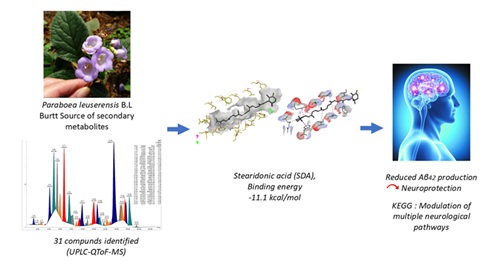
Screening the Active Compound Profile and Mechanisms of Paraboea leuserensis B.L. Burtt on PSEN1 Human Gene: UPLC-QTof-MS Identification and Molecular Docking Analysis Study
Pages 754-772
https://doi.org/10.48309/ajca.2026.557629.1964
Safni Safni, Syafruddin Ilyas, Yurnadi Hanafi Midoen, Sepriyaldi Sepriyaldi, Salah Abdalrazak Alshehade
Abstract This research investigated the neuroprotective potential of secondary metabolites derived from Paraboea leuserensis B.L. Burtt, focusing on their interaction with the PSEN1 gene pathway in neurodegenerative diseases. Thirty-one secondary metabolites were identified through UPLC-QTof-MS analysis. Molecular docking revealed that seven compounds showed significant binding affinity to the 8OQY receptor protein of the PSEN1 gene, which was crucial for gamma-secretase activity and amyloid-beta (Aβ) production. Stearidonic acid (SDA) emerged as the most promising competitive inhibitor, with a binding energy of -11.1 kcal/mol, effectively binding to multiple sites in the PSEN1 pathway proteins and potentially reducing Aβ42 production. KEGG pathway enrichment analysis suggested that these compounds modulated various neurological pathways, indicating a multi-target therapeutic approach. These findings highlighted the potential of Paraboea leuserensis B.L. Burtt compounds as modulators of the PSEN1 pathway for Alzheimer's disease, warranting further experimental validation.